Please update your bookmarks and visit that site for current news and events, including event registration. To give to UMN Libraries, visit www.lib.umn.edu/about#giving.
This site (libnews.umn.edu) has been preserved as an archive and will be available until at least 2028.
Student success
Student savings
In FY23, Library course materials were embedded in 3,346 course sections. More than 57,161 items (including multi-use e-books, open textbooks, and licensed journal articles) reached 88,144 students.
If every student took advantage of these resources, the potential savings would have been $6.5M in FY23.
Targeting textbooks
In the PSY 3011 class, the Libraries saved students $40,000. Watch the Targeting Textbooks video below.
Students helping students
Our Peer Research Consultants (PRCs) are students trained to help other students with research papers and assignments — while also guiding interested students to faculty so they can work on impactful research projects.
All told, PRCs interacted with over 4,000 students, including:
268 one-on-one research consultations
Helping students with research assignments in 73 different courses
Providing feedback to 220 first-year writing students
The PRC “was super helpful in not only providing me with more research knowledge but also in making me feel more relaxed with [my] research progress.” –U of M undergraduate student
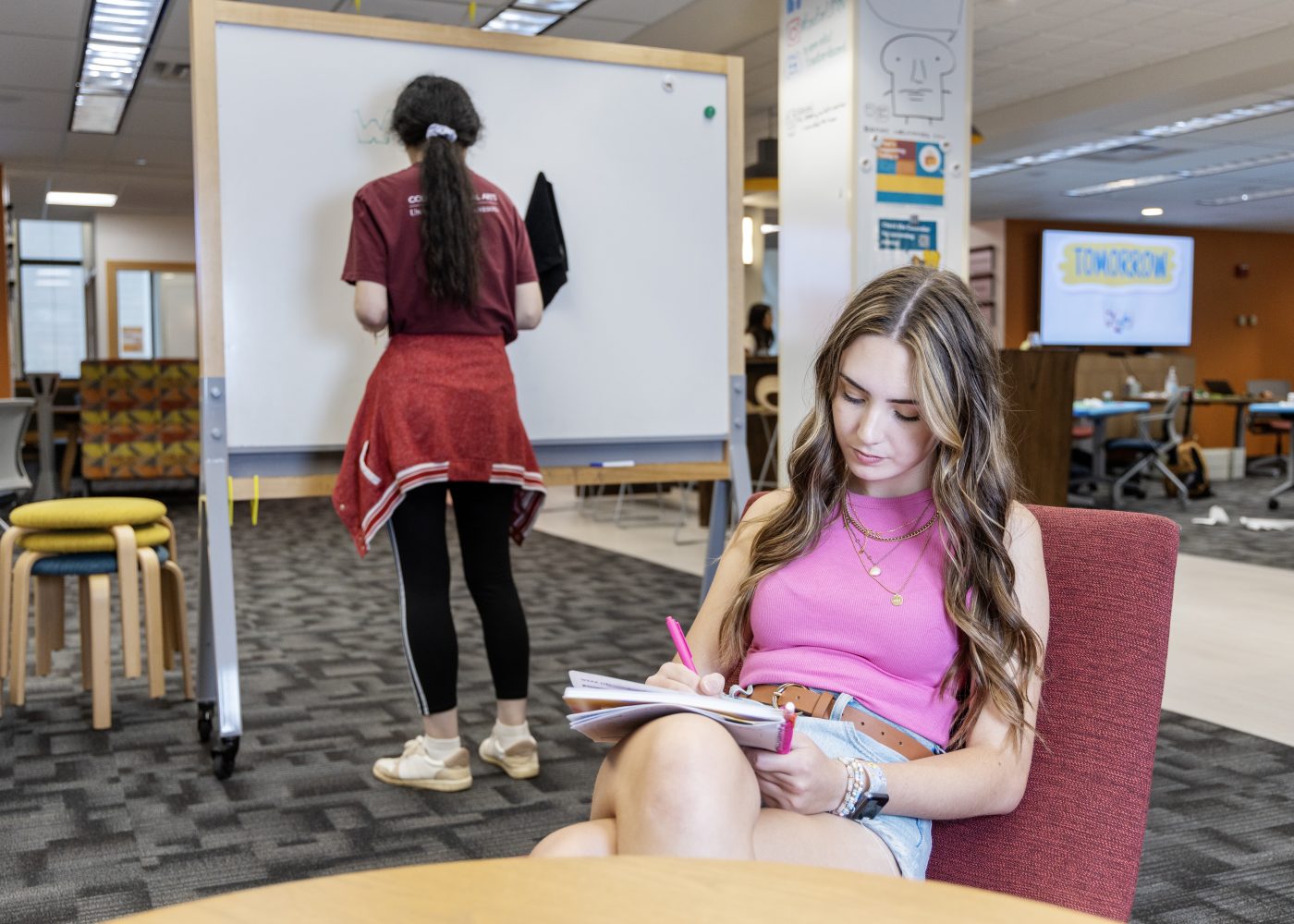
The Toaster champions student innovation
The Toaster Innovation Hub has room for almost anything. This summer, it hosted the Business Innovation Academy, a two-week-long immersion camp for middle school students, and the Emerge Summer STEM Program, a free four-week program for incoming President’s Emerging Scholars students.
The Toaster has long championed student innovation. During the MVP challenge, 25 teams learned the basics of prototyping and entrepreneurship at monthly workshops, and worked on projects like a carb counting application for children with Type 1 diabetes.
The Toaster “gave me certainty during many, many uncertain times. If you face the challenge with someone, you can work together to transform the challenge into learning opportunities for everyone.” –Jackie Liu, Ph.D. candidate in Human Resource Development in the College of Education and Human Development
(Photo/Adria Carpenter)
Instruction, library guides, and tutorials
Library staff in the health sciences collaborated with the School of Dentistry to reimagine the History of Dentistry section of its Professionalism course. Year 1 dental students were able to understand the past, present, and future of their profession by interacting with rare books and artifacts. Using a World Cafe class structure with facilitators and StoryMap timeline, students examined topics including oral and systemic health; diversity, equity, and inclusion; health and dental disparities; and more.
In FY23, staff taught 519 classes, including 835 sessions (some of the classes received multiple visits).
The Libraries also offer online guides and tutorials to help students in their coursework and research.
Total views for library guides: 457,433
Total views for online tutorials: 110,246
Improving health care in the VR Studio
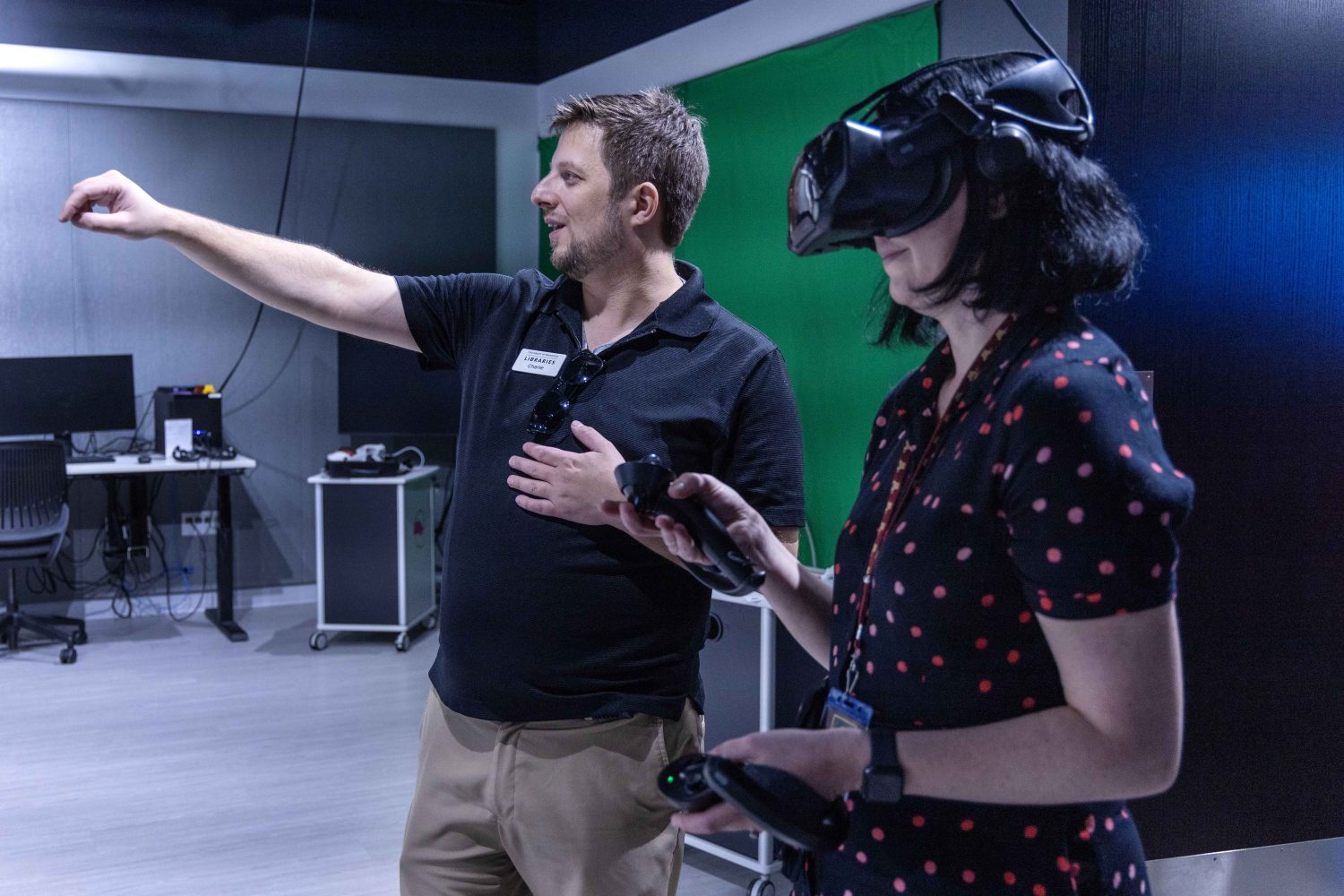
At the Health Sciences Library’s Virtual Reality (VR) Studio, medical students are running simulations in a clinical setting to test how efficiently and accurately they can diagnose and treat patients. There are 10 different, timed scenarios with virtual patients who appear with certain symptoms. Other simulations include an Emergency Medicine Advanced Rotation, which helps students manage common life-threatening emergencies they’ll encounter throughout their career. After each simulation, students meet in groups with a facilitator to discuss what they learned.
Charlie Heinz explains the anatomy simulations in the VR Studio. (Photo/Adria Carpenter)

 : For Students, Faculty, and Staff